


Reliable Water Purification Services for Industrial Applications
Veolia Water Technologies offers a continuous supply of high-quality deionized water through our fully managed service deionization (SDI) program. Our deionized water service includes delivery, exchange, regeneration, and return of all SDI units – ensuring operational continuity without the need for onsite regeneration or chemical handling.
Flexible Plug-and-Play Deionized Water Systems
We supply a large range of exchangeable cylinders with a variety of water purification media to suit your application. Our deionized water systems are easy to install and operate, and will produce the grade of deionized water you require when you need it:
- Activated Carbon
- Cation Deionizers
- Anion Deionizers
- Mixed Bed Deionizers
Benefits of Our Deionized Water Service
- Strict quality control
- Easy and convenient cylinder exchange
- Minimal space required
- No chemicals handling or storage required
- No wastewater or effluent to drain
- Easily upgradable to meet more demanding quality or flow requirements
- Flexibility
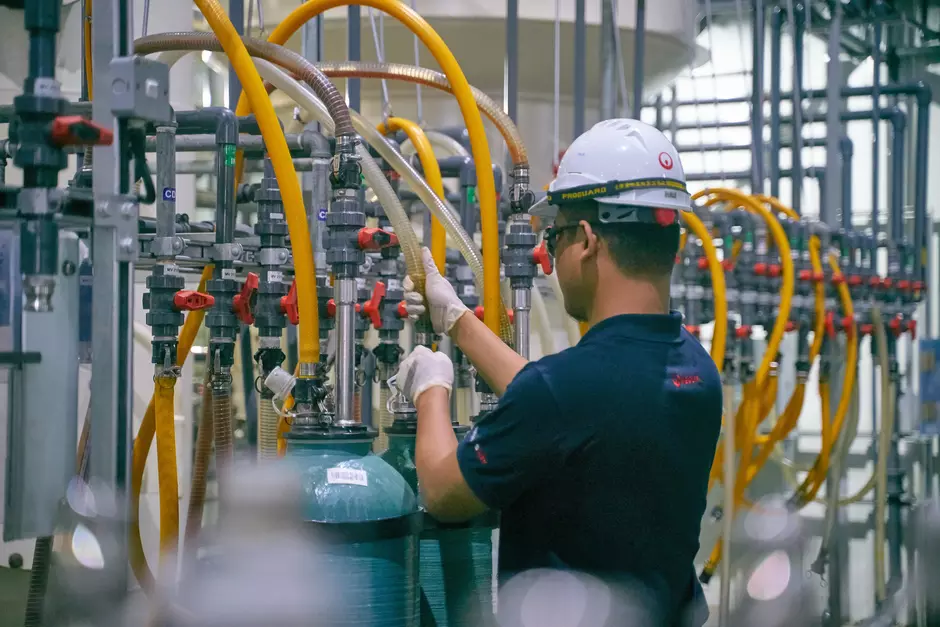
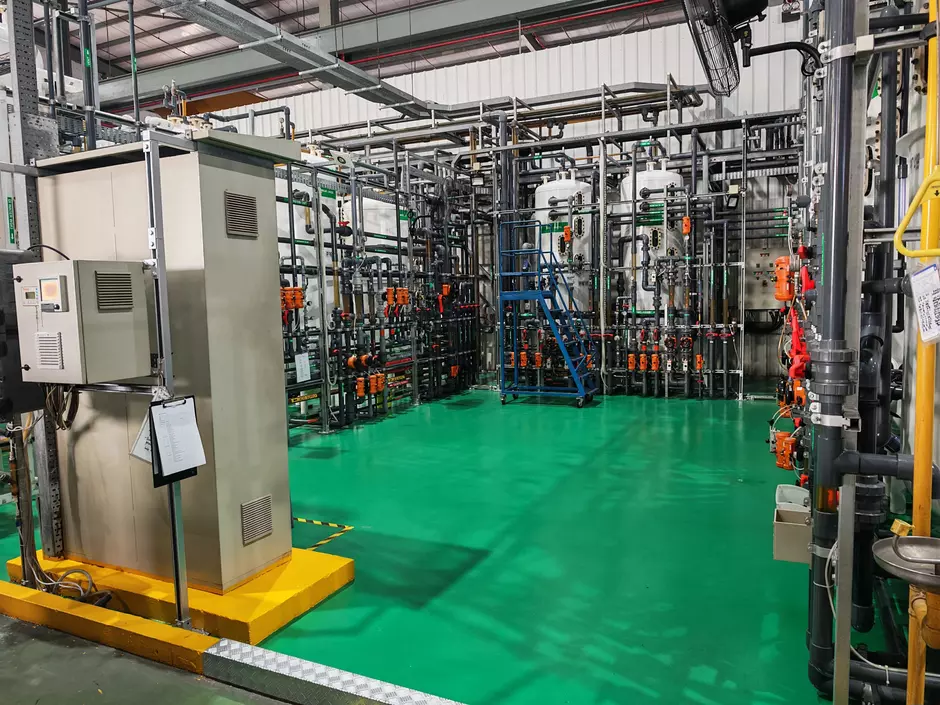
Regeneration & Service Deionization
Based at our Penang facilities, the fully automatic, state-of-the-art Regeneration Center was designed by our in-house engineering department, bringing over 30 years' experience in the handling of ion exchange resins for deionized water systems. It also ensures efficient regional logistics and faster turnaround for customers across Malaysia and Southeast Asia.
The Regeneration Plant supports four Service Deionization (SDI) products and Mobile Water Solutions, ensuring a consistent supply of high-quality deionized water for industrial use.
With high levels of water recycling and minimization of resin disposal, this state-of-the-art process couples the highest quality resin regeneration with true duty of care in environmental management – delivering sustainable, reliable water purification services as part of our complete deionized water service offering.
Take A Virtual Plant Tour
FAQ
Deionized water is water that has had most of its dissolved mineral ions—such as sodium, calcium, iron, and copper—removed through a process called deionization. This results in high-purity water that is often used in laboratory, industrial, and medical applications where impurities must be minimized.
Deionized water is produced by passing water through ion exchange resins, which replace undesirable cations and anions in the water with hydrogen (H⁺) and hydroxide (OH⁻) ions. These ions then combine to form pure water (H₂O), effectively removing dissolved salts and minerals.
Deionized water is used in a variety of industries, including pharmaceuticals, laboratories, electronics manufacturing, automotive cooling systems, and any process where mineral-free water is essential to prevent contamination or scaling.
The main difference between RO (reverse osmosis) and DI (deionized) water lies in their purification methods and the types of contaminants they remove. RO water is produced by forcing water through a semi-permeable membrane, which removes a wide range of impurities, including dissolved solids, organic compounds, and some microorganisms. In contrast, DI water is produced by using ion exchange resins to remove only ionic contaminants, such as minerals and salts. For applications requiring ultra-pure water, RO and DI processes are often used together.